Local blog on transportation issues along Interstate 66.

Showing posts with label buses. Show all posts

Tuesday, February 16, 2010

Contingencies

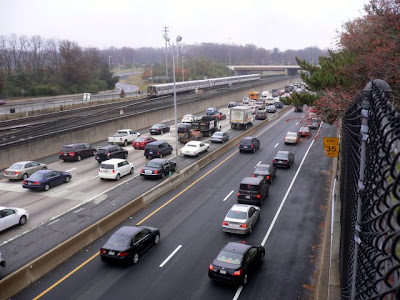
After witnessing last Friday's traffic jams, one wonders if maybe the I-66 corridor needs more contingency plans. Friday's gridlock was like the entire region returning to work as if public transportation didn't exist. The government's delayed opening meant rush hour started around the time HOV restrictions were lifted. We all had no option but to drive.

The Orange Line's aerial track between Vienna and Ballston was impassable, and commuter buses that run on I-66 and the Dulles Toll Road couldn't feed into Vienna and West Falls Church stations. But Metrobuses running on major roadways like routes 7, 29, and 50 ran when road conditions improved. It seemed as if VDOT did a better job clearing major roadways than WMATA did with railways.

What if the commuter buses weren't completely reliant on the Orange Line? Had they run Friday, could they have attracted enough ridership to reduce the gridlock or would the buses from Centreville and Reston simply have gotten stuck in the two-hour traffic jams and produce busloads of irate passengers vowing never to ride a bus again? Would they just create chaotic overcrowding at snow terminal stations like Ballston, which were already overloaded and running at reduced capacity?

Blizzards aren't frequent, but Metrorail disruptions seem to happen almost every week. A derailing happened near Farragut North on Friday. The deadly crash on the Red Line last year disrupted service for months.

If something happened to the Orange Line, would we be reduced to daily crippling gridlock like Friday's?

Even if the regional priority bus network doesn't get TIGER funding this week but especially if it does, we need to think about a more resilient and flexible transportation system.

Photo credit: Paulo Ordoveza

Wednesday, February 3, 2010

Town Hall Meeting on I-66 Traffic

Local politicians including Rep. Frank Wolf and county supervisors Mike Frey and Pat Herrity (all representing the Centreville area and western Fairfax County) are hosting a town hall meeting about traffic on Interstate 66 with a panel of experts.

Wolf has long been a proponent of bus rapid transit, but BRT is a nebulous term so here's his chance to explain exactly what he means and discuss options. Are we talking an Orange Line extension via BRT with Metrorail-like service? Are we talking priority buses that can avoid congestion and bottlenecks? Are we talking something marginally better than the west county Connector buses we have now?

Wolf's press release also mentions:
increasing the use of shoulder lanes, opening the Monument and Stringfellow interchanges by non-HOV vehicles outside of normal HOV hours, and improvements to the interchange at I-66 and the Beltway.
And how about revising high-occupancy vehicle restrictions on the highway, huh? Considering (1) how slow HOV "express" lanes can get and (2) how bad I-66 can be get as soon as HOV restrictions lift, and (3) how long it's been since the last HOV update, we should be at least thinking about better HOV rules.

The public meeting is scheduled for this Saturday (Feb. 3) at 10 am in Chantilly High School. Weather forecasts at present are implying the event is likely to be postponed. But please attend this meeting whenever it is held. Stay tuned for details. The meeting has been cancelled.

Wednesday, November 25, 2009

A Case for Priority Buses on I-66

Today was a rarity. I actually got to work faster by bus than I would have by car. I monitored traffic on the web before I left, and I saw the backup from the Orange Line train out of Vienna. I was at work in an hour. The rain and pre-Thanksgiving Beltway bottleneck would have meant at least an hour and a half in a car. Usually public transit just can't compete with the door-to-door service of an automobile; time savings isn't one of the benefits with taking the bus.

So, how did this happen?

One factor was just luck. Buses arrived just in time to make transfers. Usually you have to wait like ten minutes or more for transfers.

Another factor was flexibility. My default way to work involves a bus-to-bus transfer -- the most direct route to the doorstep of my office. Today I took a more circuitous option (bus to Metrorail to another bus) but arrived at my destination faster. Why?

Buses going inbound in the morning (such as my direct option) get caught up in delay just as any vehicle with wheels on the road. Texting NextBus confirmed that bus was indeed very late. So I took Metrorail past the mess and then hopped a bus going outbound (opposite peak traffic).

A third factor was circumstance. Usually buses on Interstate 66 get stuck in traffic just like any vehicle, regardless of occupancy. The high-occupancy vehicle lane on the far left is useless to buses from Centreville after Route 123 because they have to get off on the far right, onto Nutley Street to get to the Metro station. (That express lane is also useless to through traffic after Nutley because the backup getting on the Inner Loop is so bad.)

Today the driver of the bus stayed in the HOV lane till the last minute, cutting across traffic lanes rather late in the game. I'm pretty sure the bus isn't supposed to do that and I'm pretty sure the collective grumpiness of the situation wasn't letting the bus in at its usual merge point. This is actually a dangerous situation, especially in the rain, but the effect was that the bus cut ahead and didn't inch along in traffic as much as it usually does.

A personal factor was willingness to walk. I opted to take the first bus available, which dropped me off three blocks from office instead of the one that drops me off in front. The weather even cooperated with me enough to stop raining when I was on foot. With all the extra time, I dropped by a store to pick up some stuff. I could have sat down for a full breakfast with the morning paper in the pancake house with all that extra time.

So what's that all mean?

Having various ways (and modes) to get to work is a Good Thing. If you aren't ready for the situation, you can't just jump on the best option. In my case, I'm familiar with the traffic patterns and how the highway bottlenecks impact my drive -- I even get updates on my phone. And I know public transit options -- with or without Metrorail, plus their pros and cons. If I hadn't been prepared, I would have been stuck in traffic or waiting over an hour for a bus. I would have been late to work, which isn't a tragedy, but it is annoying and no where as rewarding as time for a sit-down breakfast.

Flexibility is important on a macro scale as well. What if an accident closes down I-66 or the Orange Line or a glitch shuts down traffic lights along Routes 29 or 50? These kinds of incidents aren't rare lately, and transportation choices help people avoid jams and the region accomodate the occasional mishap.

Today's scenario highlights how the perfect and exceedingly rare alignment of factors puts the bus (plus Metrorail) ahead of a car commute. It doesn't instill confidence in buses, but it shows how buses could be better, how so-called priority buses could benefit all users of I-66, drivers and riders alike.

Most people don't take the bus because it takes too long. In my case, I actually have to transfer to another bus, which is a total deal breaker for most. And buses have to wait in the same traffic as single-occupancy vehicles. But is that fair and what if they didn't?

If an SOV is held up in traffic, one person loses, say, 20 minutes. If a bus is held up, a busload of people lose 20 minutes each -- many hours of lost productivity on a single trip. That's also a busload of discouragement with transit and a busload about to get back in their cars, which makes the I-66 situation worse.

What if the bus didn't wait in traffic like all the SOVs? What if a more exclusive express lane wasn't as clogged as the others? What if the ramps at Vaden Drive, as proposed, let buses bypass the mess at Nutley? What if the Beltway high-occupancy toll lane contruction made the HOV lane usable by express buses clear to downtown? What if today's rarity wasn't so rare?

Suddenly the bus would be winning over more hearts and minds because it wouldn't be running at such a time deficit. It would be more marketable to more people and more competitive against the highway. And the real win-win is that the more people taking transit (because it benefits them!) makes the road more pleasant for those who can't take transit.
Wednesday, October 28, 2009

Autumnal Roundup

It's back to school season or at least townhall-style meetings in school cafeterias.
  • The Virginia Department of Rail and Public Transportation held public meetings in September discussing preliminary findings from their study of short- and midterm transit options on I-66. They're thinking mostly bus service improvements, and the study will be finalized next month.
  • Metro is facing a budget shortfall and has held public meetings to discuss the topic in D.C. and Virginia. (Maryland meetings are scheduled for next month.) Service cuts, fare increases, increased contributions from participating jurisdictions, and other options are to be considered.
  • Fairfax County is holding a series of meetings on its 10-year plan for bus service. Attend the meetings to learn about bus service, give input, and participate in the development of service recommendations. The remaining meetings are all scheduled weeknights, 6 to 8pm.


Interstate 66 is what state transportation secretary calls Northern Virginia's most congested and challenged corridor and he says its high-occupancy vehicle program needs to be updated (possibly longer, higher, and/or both directions). Others are calling for high-occupancy toll lanes. That said, if nearly half of I-66 commuters take transit, imagine what the highway would be like if more or less took transit.


For Tysons commuters, Fairfax County is starting a free lunchtime shuttle bus operating every ten minutes on two routes in Tysons Corner. If you bus or carpool to Tysons or if you want to just give your car a lunch break during the mid-day rush hour, then this service is probably for you.


Foreclosure rates in the outer suburbs have increased, according to a report in The Examiner. Looks like Fairfax County isn't in as bad a shape as Loudoun, Prince George's, and Prince William counties. But Fairfax's rate is still more than twice as high as its other neighbors.

Monday, October 19, 2009

Stone Road Park and Ride Full


I wandered the aisles around 8:35am (just before the 8:40 departure of FC 442) and there was but one parking spot left. (The two cars pictured are probably going to find that one spot already full.) Maybe I don't pay a lot of attention to the parking situation because I prefer to bike to the park and ride, but it seems like it's been quite a while since the Stone Road park and ride has been at capacity.

Ironically, on the way to Vienna, Interstate 66 seemed surprisingly uncongested -- with no backup within sight of Nutley Street as the bus got off toward the Metro station.

Photo by the author.

Friday, September 25, 2009

TIGER on the I-66 Corridor?

Last week was the deadline to apply for grants under the Transportation Investment Generating Economic Recovery (TIGER) program, part of the federal stimulus packaged passed earlier this year. The criteria by which TIGER grant proposals are judged are many, but long-term benefit gains with short-term implementation (i.e., projects that can begin now), economy-stimulating potential, and innovation look like they lead the list. The Washington Metropolitan Council of Governments put together a proposal of three packages, each with some impact on the I-66 corridor.

The first package describes a network of priority bus corridors, the centerpiece of which is the K Street Transitway subpackage focused on improving accessibility and mobility in the city core, the final destination for many surburban commuters. The only component actually on I-66 is a ramp in the median of I-66 providing direct access to and from the left express (HOV) lanes to the Vienna Metrorail station. That could mean big time savings for commuter buses that get caught in the rush-hour backup around the Nutley Street exit. It can also mean less disruption to traffic and a safer situation for buses trying to weave from leftmost HOV lane to the rightmost turn lane.

Also mentioned in the package are new park-and-ride lots and information technology improvements such as real-time bus information (with a mobile web application), bus information displays, cameras on buses, computer-aided distpatch and automatic vehicle location technology, and clean-fuel bus replacements.

The second package is a regional bicycle-sharing program that would put bike-share stations across the region, including Arlington County and the City of Fairfax. The region-wide program also includes so-called high-tech intermodal smart hubs that provide transit information and facilitate transfer from different modes (such a bicycle to Metrorail or Zipcar).

The third package details some accessibilty and capacity improvements to the overcrowded Rosslyn Metrorail station.

The U.S. Department of Transportation will announce which projects will receive TIGER grants between September 22, 2009, and February 17, 2009.
Graphic credits: diagram of proposed priority bus corridors by MWCOG, Montreal Bixi bike-sharing by Comrogues).

Wednesday, September 9, 2009

Post-Labor Day Roundup

Stimulus now hitting commuter rail. Virginia Railway Express is reported to receive $9.8 million in federal stimulus money for 12 new locomotives and a canopy at the Manassas Park station. A VRE spokesman said via The Washington Post that new running stock is more efficient and can pull more passengers than the 20 aged locomotives currently in use. VRE operates commuter trains along the I-66 and I-95/I-395 corridors to downtown D.C.
  • The Post: "Two Transit Agencies Get $14 Million From Stimulus"
Ridership is up across the state but not so much in Northern Virginia. So says a recent transportation report, according to Inside NOVA. VRE ridership is up, and buses in the Prince William area are also seeing a modest increase, but ridership in Fairfax County and Alexandria is actually a bit down.
  • Inside NOVA: "State Transit Ridership Slowly Increases"

It's a bad year for pedestrians in Fairfax County. Fatalities are way up. Please drive and walk safely.
An I-66 corridor transit study will be complete this fall. And the Virginia Department of Rail and Public Transportation (DRPT) will be hosting public information meetings to review findings and receive comments in the last two weeks of September. The study was commisioned to evaluate short- and midterm improvements to the corridor, such as bus rapid transit, car- and vanpooling, and park-and-rides.
A Virginia megaproject has been defered. Plans for high occupancy toll lanes on I-395 and I-95 have been put on hold and a Virginia official explained via The Washington Examiner that the current credit market and community concerns are big factors in the reassessment. One such concern is Arlington County gearing up for a lawsuit in opposition. Residents of Arlington and Alexandria are alarmed over the potential negative impact HOT lane construction would have on their communities, especially around Shirlington Circle.
The HOT lanes currently under construction on I-495 (between the Dulles Toll Road and the Springfield interchange) are unaffected by the I-395 decision.

Wednesday, July 29, 2009

Dog Days Roundup

Faster, better buses on I-66 and into the city. The I-66 corridor is part of a regional priority bus network plan taking shape in an attempt to snag federal stimulus money for transportation improvements that can be implemented quickly (i.e. "shovel ready"). Regional planners are putting together a proposal of "phase one" improvements that can be completed by Feb. 17, 2012, and qualify for TIGER grant funds. Rapid bus service on managed lanes on I-66 and I-95 (which could include "trunk line facilities, including new inline stations, and director indirect access to major destinations, including the Pentagon, Tysons Corner, and Franconia/Springfield"), priority bus improvements on the freeway bridges across the Potomac River, and a K Street transitway are on current proposal materials. Planners will finalize the proposal by August and submit for the grant in September.
Preventing buses from getting stuck in the same traffic as single-occupant vehicles between Route 50 and the beltway would give transit a leg up to consumers, but let's see how this plays out next month.

Wider I-66 with better buses. Rep. Frank Wolf (R) is in the news for what he's pushing in the annual transportation bill that passed the House last week. Wolf wants the following considered: extending the rushour window for usage of the highway's shoulder, spot improvements and widening outside the Beltway, and HOT ramps at Monument Drive and Stringfellow Road. Wolf is also a proponent of bus rapid transit.
The stimulus starts to hit the region. And the Fairfax County Parkway is the local "shovel ready" favorite apparently. Money goes to an interchange over Fair Lakes Parkway (between the existing interchanges at I-66 and Route 50) and an extension past Rolling Road in Springfield to Fort Belvoir, a major mecca for military-related jobs. Metro and VRE are also getting money.
How many in Centreville commute down I-66 to the Pentagon? What happens when they take their commute down to Fort Belvoir? Rep. Jim Moran (D) says the region's roads and transit network aren't ready the massive military job relocation to come.
  • WTOP: "BRAC Move to Fort Belvoir Will Create 'Chaos'"
Chuck a workie (not a sickie) on Aug. 3. Gov. Tim Kaine (D) is promoting Telework Day to encourage more individuals and organizations to consider telecommuting or work-at-home arrangements. Anything that increases business productivity and worker flexibility, such as skipping a long commute whenever possible or avoiding rush hour should be explored. If you need a reason, tell your boss the governor said so.
  • WHSV 3: "Kaine Asks Virginians to Telework August 3"
  • CommuterPageBlog: "Go Green with Va. and Telework August 3"
Gubernatorial hopefuls vie for Richmond by way of Northern Virginia. Republican Bob McDonnell announced a transportation plan. Democrat Creigh Deeds hasn't released as much detail yet. The two nominees do agree on tax credits for businesses that have telework programs.
Transit fare prices increase across the region. Riding VRE or driving the Dulles Greenway is now pricier. The Dulles Toll Road will likely increase fares soon as well to fund the Metrorail extension. And the Fairfax Connector buses that took over Metrobus routes around Centreville are a tad pricier than the old Metrobus special fare. On the other hand, gas prices are kinda sorta almost low or lower than before at the moment.
A plan to privitize potties fails. The Virginia Department of Transportation is shuttering the rest area off I-66 in Manassas in September; other areas throughout the state already closed down. A number of politicians called for the privitization of the potties by changing the federal law that prohibits such, but the amendment by Rep. Frank Wolf failed in committee.
  • VDOT: "Rest Area Closures to Begin July 21"
  • The Post: "If Drivers Have to Go, They Have to Go Far"
  • WHSV 3: "Amendment to Change Federal Rest Area Law Fails"
And Virginia has a website to keep track of so-called megaprojects in Northern Virginia.

Thursday, July 2, 2009

Independence Day News Roundup

Start thinking about more transit on the I-66 corridor. Reps. Gerry Connolly (D) and Jim Moran (D), both of Northern Virginia, are pushing for federal funding to begin study of an extension of Metrorail's Orange Line to Centreville. Virginia Railway Express (VRE) is moving forward with an environmental study on a proposed expansion of the Manassas Line to Gainesville and Haymarket. Meanwhile, the Virginia Department of Rail and Public Transportation (DRPT) is studying the I-66 corridor for more short- and medium-term fixes, such as bus rapid transit.

The county has no money. And as a county, Fairfax is reliant on the state transportation department (VDOT) and federal handouts for most transportation projects. VDOT allocated the county virtually nothing for new secondary road construction this year, but federal stimulus is funding highway construction at the Fair Lakes interchange and the extension of the Fairfax County Parkway to Fort Belvoir.

What if the county were a city? If Fairfax County were a city, as the county executive recently suggested, Fairfax would be the largest city in the region, bigger than Baltimore, D.C., Richmond, and Virginia Beach. And Fairfax as a city would have more independence from the state's central departments of transportation and taxation to take such matters into its own hands.
  • The Washington Post: "Fairfax Executive Suggests Dropping 'County'"
  • WTOP: "Should Fairfax County Change Its Name?"
  • The Examiner: "Unhappy with Roadwork, Fairfax Eyes Becoming City"

Fairfax Connector took over former Metrobus routes in western Fairfax County. If you take a bus in Centreville, Chantilly, or Oakton (12's, 20's, 2W), check the Fairfax Connector website for new route numbers and any schedule changes.

Offbeat: Centreville Baptist Church has moved its sign off Route 29. The sign facing southbound traffic was of the large wheeled flashing variety usually used to alert drivers to dangerous or special conditions, but the message was an invitation for men to attend the church's prayer service.
  • WTOP: "Church Asks Foregiveness, Moves Road Sign"