Local blog on transportation issues along Interstate 66.

Showing posts with label Metrobus. Show all posts

Tuesday, February 16, 2010

Contingencies

After witnessing last Friday's traffic jams, one wonders if maybe the I-66 corridor needs more contingency plans. Friday's gridlock was like the entire region returning to work as if public transportation didn't exist. The government's delayed opening meant rush hour started around the time HOV restrictions were lifted. We all had no option but to drive.

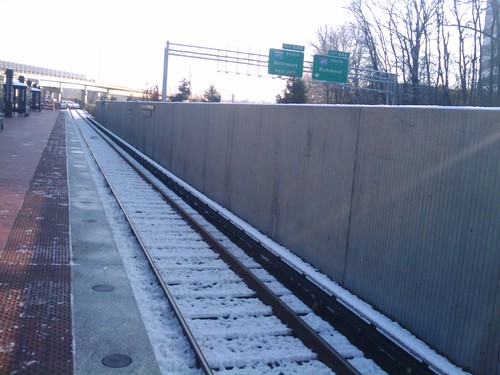
The Orange Line's aerial track between Vienna and Ballston was impassable, and commuter buses that run on I-66 and the Dulles Toll Road couldn't feed into Vienna and West Falls Church stations. But Metrobuses running on major roadways like routes 7, 29, and 50 ran when road conditions improved. It seemed as if VDOT did a better job clearing major roadways than WMATA did with railways.

What if the commuter buses weren't completely reliant on the Orange Line? Had they run Friday, could they have attracted enough ridership to reduce the gridlock or would the buses from Centreville and Reston simply have gotten stuck in the two-hour traffic jams and produce busloads of irate passengers vowing never to ride a bus again? Would they just create chaotic overcrowding at snow terminal stations like Ballston, which were already overloaded and running at reduced capacity?

Blizzards aren't frequent, but Metrorail disruptions seem to happen almost every week. A derailing happened near Farragut North on Friday. The deadly crash on the Red Line last year disrupted service for months.

If something happened to the Orange Line, would we be reduced to daily crippling gridlock like Friday's?

Even if the regional priority bus network doesn't get TIGER funding this week but especially if it does, we need to think about a more resilient and flexible transportation system.

Photo credit: Paulo Ordoveza

Thursday, October 22, 2009

Metro Talks Finances, Seeks Input on Budget Shortfall

At a public forum last night in Northern Virginia, transit officials, representatives from local jurisdictions, and Metro riders discussed the value and needs of the area's major transit operator in the wake of the economic recession. Metro faces a projected budget shortfall of more than $100 million for operations in fiscal year 2011 in addition to capital improvements estimated to cost $11.4 billion over the next 10 years, according to the opening presentation by John Catoe, Metro's general manager. Officials responded to comments and questions from forum participants about how Metro can balance its budget.

Most commentators emphasized that service cuts would be detrimental, both to the region as a whole and to the lives of many users reliant on the transit system. Some commentators viewed fare increases as unwelcome but preferable to service cuts. Users of MetroAccess, a paratransit service operated by Metro for people with disabilities, were concerned that the level of service they receive now, higher than what is mandated by federal law, could be reduced.

Fairfax County supervisor Pat Herrity (Springfield) recommended consideration for contracting bus service and "giving these bus routes back to the jurisdictions," citing how his county contracts bus operators for the routes assumed from Metro in Reston and Centreville. "Competition is something that could lead to lower fares, increased service, and a better system," Herrity said, after noting that Fairfax Connector's contractors have saved the county money and improved service.

Metro's biggest expense category, "personnel" in the presentation's pie chart, led to discussions about Metro employee salary and the benefits packages. Catoe insisted that reports that some employees receive extraordinary compensation due to overtime are rare cases that should become rarer. Pensions, another large personnel expense, are in a sticky situation, according to Metro director Chris Zimmerman, who explained that Metro's obligations to fund pensions for employees was inherited from the bus operations the infant transit agency assumed 30 years ago, and for legal reasons can't be modified without arbitration.

A number of commentators and officials, including Herrity and Zimmerman voiced support for priority bus improvements -- road and route modifications that allow buses to bypass normal traffic -- which could reduce costs by allowing buses to move more people faster with fewer vehicles and less fuel. Catoe was recognized for his personal experience implementing dedicated bus lanes in Los Angeles, and he said busways that once existed in the D.C. area's past should be brought back.

Catoe's presentation detailed the value of Metro service to the greater community in terms of transportation, economics, and the environment before providing a background on the budget situation.
  • Metro's biggest sources of funds are state and local contributions (39%), fare and parking (33%), and federal contributions (20%);
  • Metro's biggest uses of funds are personnel (45%) and capital costs (i.e., new buses, trains, stations, etc., 35%); and
  • average fare subsidies per passenger (i.e., estimated cost of a ride not covered by its fare) are $37.89 for MetroAccess, $2.46 for Metrobus, and $0.54 for Metrorail.
Also noted are some of the "cost drivers" of the budget gap (slide 16 or page 9):
  • contractual union wage and benefit obligations,
  • pension contributions,
  • fuel and energy inflation,
  • escalating claims costs,
  • security,
  • maintenance of an aging system, and
  • decreased due to ridership decline.
[I actually had to leave at 9pm before the meeting wrapped up (to catch a bus, naturally). So if anyone at the meeting, especially anyone who stayed to the end, has anything to add, please comment.]


Photo credit: Metrobus by Jason Lawrence.

      Thursday, July 2, 2009

      Independence Day News Roundup

      Start thinking about more transit on the I-66 corridor. Reps. Gerry Connolly (D) and Jim Moran (D), both of Northern Virginia, are pushing for federal funding to begin study of an extension of Metrorail's Orange Line to Centreville. Virginia Railway Express (VRE) is moving forward with an environmental study on a proposed expansion of the Manassas Line to Gainesville and Haymarket. Meanwhile, the Virginia Department of Rail and Public Transportation (DRPT) is studying the I-66 corridor for more short- and medium-term fixes, such as bus rapid transit.

      The county has no money. And as a county, Fairfax is reliant on the state transportation department (VDOT) and federal handouts for most transportation projects. VDOT allocated the county virtually nothing for new secondary road construction this year, but federal stimulus is funding highway construction at the Fair Lakes interchange and the extension of the Fairfax County Parkway to Fort Belvoir.

      What if the county were a city? If Fairfax County were a city, as the county executive recently suggested, Fairfax would be the largest city in the region, bigger than Baltimore, D.C., Richmond, and Virginia Beach. And Fairfax as a city would have more independence from the state's central departments of transportation and taxation to take such matters into its own hands.
      • The Washington Post: "Fairfax Executive Suggests Dropping 'County'"
      • WTOP: "Should Fairfax County Change Its Name?"
      • The Examiner: "Unhappy with Roadwork, Fairfax Eyes Becoming City"

      Fairfax Connector took over former Metrobus routes in western Fairfax County. If you take a bus in Centreville, Chantilly, or Oakton (12's, 20's, 2W), check the Fairfax Connector website for new route numbers and any schedule changes.

      Offbeat: Centreville Baptist Church has moved its sign off Route 29. The sign facing southbound traffic was of the large wheeled flashing variety usually used to alert drivers to dangerous or special conditions, but the message was an invitation for men to attend the church's prayer service.
      • WTOP: "Church Asks Foregiveness, Moves Road Sign"