Local blog on transportation issues along Interstate 66.

Monday, January 25, 2010

Belated New Year Roundup

Well, it's almost lunar new year.

The new overlords are in. Virginia's new governor, Bob McDonnell (R) says transportation is not on his agenda this year but he is using emergency money to reopen highway rest areas. He also wants to raise highway speed limits in rural areas.

Meanwhile the Beltway is winning accolades. If you thought the congestion at I-495 was bad, you weren't alone. The Daily Beast says the Capital Beltway is #3 among national bottlenecks. No surprise there.

Mind your vehicle occupancy. There have been many media reports of high-occupancy vehicle enforcement on I-66 since December. Fines are pricey and violations have been many. If you need a review on the region's HOV restrictions, check with the Commuter Page.

Metro is seeking input on its big budget decision. The region's transit backbone (Metrorail and Metrobus) has to cut service and/or raise fares and is presenting four options.

And some sorta good news. Fairfax Connector has adjusted schedules, including Centreville's 442 and 444 to Sully Station and Stone Road. This should mean a little more service and more frequent buses during peak periods. Check out the new schedules if you're a minute minder.

Sorry for the holiday hiatus. We're back.

Photo credit: Tom Saunders, VDOT

Tuesday, January 19, 2010

The 15 Minutes the Earth Stood Still

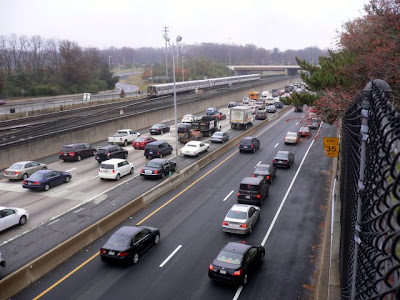
Just before 10 am this morning on eastbound I-66 approaching the Beltway interchange, an incident brought traffic to a 15-minute standstill. Traffic reporters said a motorcade was moving through the Falls Church area and on the Beltway. People got out of their idling cars to stretch. WTOP confirms that the president was visiting a local school.

Motorcades are another traffic incident the area deals with, but backup at the Beltway happens almost everyday with or without the Obama administration dropping by. Traffic getting on the Beltway on the left and right lanes of I-66 often often clog the middle lanes for through traffic.

Partly to blame is the ongoing construction of high-occupancy/toll lanes on the Beltway, which worsens the bottlenecks at the I-66/I-495 interchange. This interchange is being reconfigured to accommodate HOT lanes and ramps, new bridges, and toll facilities. Honestly, I don't know what the interchange will be like in the HOT era, but it has to better than it is now, right? Right...?

Today was just one of those days I wish I took the bus.

Photo credit: Ryan Sandridge

Friday, November 27, 2009

Thanksgiving Roundup

The Washington Metropolitan Council of Governments is finalizing Region Forward, a proposal for comprehensive region-wide guidelines on sustainable long-term growth and development. The report identifies regional problems and goals in land use, transportation, environment, energy, economy, and housing. Comments on the proposal are due by the end of the week (Nov. 30).

If you were worried the gas tax might go up, you have less to worry about. WTOP predicts hikes are a no-go with the incoming administration in Richmond. What's interesting is that both the pro- and anti-highway advocates want a higher gas tax (to fund and discourage automobile lifestyles, respectively). Virginia's (17.5 cents per gallon) is the lowest in the region (D.C., 20; N.C., 26.6; Md., 23.5; Pa., 31.1; Del., 23; W.Va., 20.5).

Meanwhile, the federal gas tax is still subject to adjustment and the problem of taxing gas is open to debate. One recent study points out that highways are largely subsidized (just like rail, buses, and other modes) and that non-users of road pay a large share of that subsidy.

Are budget shortfalls even news anymore? The Virginia Department of Transporation is facing more big cuts, with a public hearing Dec. 1 in Richmond.

A concept that Gov. Tim Kaine ran with this past summer is back: telework. Now Rep. Gerry Connolly is touting the concept for the federal government and working on legislation that would push government agencies toward more teleworking, according to WAMU. What if I-66 as it is in August were a year-round phenomenon?

The Fairfax County Times has a lot of eye-popping stats on deer and deer-related accidents, including "an estimated 400 deer per square mile" in Bull Run Regional Park, next to Centreville. (According to the Times report, a number above 20 is a reason for environmental concern.) Always drive safely, folks, and watch out for deer.

You know what suburbs are, you've heard of exurbs too, but what about boomburbs? USA Today brings us another story along the lines of housing trouble in bedroom communities. Is Centreville a boomburb? Centreville is one of the bigger clumps of residential housing in the county without a town center. Sociology professor Robert Lang recommends boomburbs become "a little less sprawly, a little more village-like with clustered development, denser housing."

Wednesday, November 25, 2009

A Case for Priority Buses on I-66

Today was a rarity. I actually got to work faster by bus than I would have by car. I monitored traffic on the web before I left, and I saw the backup from the Orange Line train out of Vienna. I was at work in an hour. The rain and pre-Thanksgiving Beltway bottleneck would have meant at least an hour and a half in a car. Usually public transit just can't compete with the door-to-door service of an automobile; time savings isn't one of the benefits with taking the bus.

So, how did this happen?

One factor was just luck. Buses arrived just in time to make transfers. Usually you have to wait like ten minutes or more for transfers.

Another factor was flexibility. My default way to work involves a bus-to-bus transfer -- the most direct route to the doorstep of my office. Today I took a more circuitous option (bus to Metrorail to another bus) but arrived at my destination faster. Why?

Buses going inbound in the morning (such as my direct option) get caught up in delay just as any vehicle with wheels on the road. Texting NextBus confirmed that bus was indeed very late. So I took Metrorail past the mess and then hopped a bus going outbound (opposite peak traffic).

A third factor was circumstance. Usually buses on Interstate 66 get stuck in traffic just like any vehicle, regardless of occupancy. The high-occupancy vehicle lane on the far left is useless to buses from Centreville after Route 123 because they have to get off on the far right, onto Nutley Street to get to the Metro station. (That express lane is also useless to through traffic after Nutley because the backup getting on the Inner Loop is so bad.)

Today the driver of the bus stayed in the HOV lane till the last minute, cutting across traffic lanes rather late in the game. I'm pretty sure the bus isn't supposed to do that and I'm pretty sure the collective grumpiness of the situation wasn't letting the bus in at its usual merge point. This is actually a dangerous situation, especially in the rain, but the effect was that the bus cut ahead and didn't inch along in traffic as much as it usually does.

A personal factor was willingness to walk. I opted to take the first bus available, which dropped me off three blocks from office instead of the one that drops me off in front. The weather even cooperated with me enough to stop raining when I was on foot. With all the extra time, I dropped by a store to pick up some stuff. I could have sat down for a full breakfast with the morning paper in the pancake house with all that extra time.

So what's that all mean?

Having various ways (and modes) to get to work is a Good Thing. If you aren't ready for the situation, you can't just jump on the best option. In my case, I'm familiar with the traffic patterns and how the highway bottlenecks impact my drive -- I even get updates on my phone. And I know public transit options -- with or without Metrorail, plus their pros and cons. If I hadn't been prepared, I would have been stuck in traffic or waiting over an hour for a bus. I would have been late to work, which isn't a tragedy, but it is annoying and no where as rewarding as time for a sit-down breakfast.

Flexibility is important on a macro scale as well. What if an accident closes down I-66 or the Orange Line or a glitch shuts down traffic lights along Routes 29 or 50? These kinds of incidents aren't rare lately, and transportation choices help people avoid jams and the region accomodate the occasional mishap.

Today's scenario highlights how the perfect and exceedingly rare alignment of factors puts the bus (plus Metrorail) ahead of a car commute. It doesn't instill confidence in buses, but it shows how buses could be better, how so-called priority buses could benefit all users of I-66, drivers and riders alike.

Most people don't take the bus because it takes too long. In my case, I actually have to transfer to another bus, which is a total deal breaker for most. And buses have to wait in the same traffic as single-occupancy vehicles. But is that fair and what if they didn't?

If an SOV is held up in traffic, one person loses, say, 20 minutes. If a bus is held up, a busload of people lose 20 minutes each -- many hours of lost productivity on a single trip. That's also a busload of discouragement with transit and a busload about to get back in their cars, which makes the I-66 situation worse.

What if the bus didn't wait in traffic like all the SOVs? What if a more exclusive express lane wasn't as clogged as the others? What if the ramps at Vaden Drive, as proposed, let buses bypass the mess at Nutley? What if the Beltway high-occupancy toll lane contruction made the HOV lane usable by express buses clear to downtown? What if today's rarity wasn't so rare?

Suddenly the bus would be winning over more hearts and minds because it wouldn't be running at such a time deficit. It would be more marketable to more people and more competitive against the highway. And the real win-win is that the more people taking transit (because it benefits them!) makes the road more pleasant for those who can't take transit.

Wednesday, November 4, 2009

Playing Chicken on I-66

I often travel Interstate 66 eastbound to Route 7 late in what is called the peak period. That's incredibly annoying, as if rush hour in its peakiness weren't annoying enough already. Traffic between Route 29 and the Beltway is hard to predict -- WAMU and WTOP don't mention it unless it's really bad, and anything less than really bad can vary between not bad and bad. Lately has been really bad.

Points of congestion are many. But the mess approaching the Beltway is usually the worse bottleneck. Traffic backs up in each lane, waiting for the glorious opportunity to get on an off ramp or break on through to the other side. (What can only pray that the Beltway's high-occupancy toll lanes will offer relief.)

But here's the tricky part. I, like most of my fellow drivers, am not party to a high-occupancy vehicle, so going solo isn't statutory inside the Beltway. As I idle before Nutley Street, my last chance to bail before the Beltway, the time is 8:43.

Do I risk getting through too early and getting pulled over by a motorcycle cop at 8:57? Or do I pull off on Nutley for a new sense of bumper-to-bumper stop-and-go on Route 29? The former is an expensive slap on the wrist (if caught), the latter a detour to more delay.

For the record, I usually take the bus. If I'm driving at the height of rush hour I have to allot about the same time anyway. Or leave later and risk being late.

But what about you? If you drive eastbound when I-66 inside the Beltway is a no-go, how do you go about it?

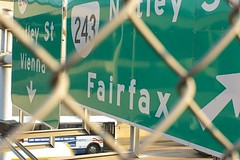
Photo credit: Nutley Street sign by Luigi de Guzman.

Sunday, November 1, 2009

The "Switching Costs" to Transit

Taking the bus or train instead of the car to work is a lot more costly than the gas you might save. There's a psychological hump to get over and there are habits that have to change. That's not money from your wallet but it's still mentally expensive.

Marketplace Money has a report on the resistance to that kind of lifestyle change in the Denver area, where the mass transit system is set for big expansion. Getting people to the point of actually ditching their cars can be tough, so says a scholar of consumer decisions to Marketplace's Andrea Bernstein:
If I've always driven, I don't have to think about when to leave, I just leave. If I switch to mass transit, I have to actually figure out what the schedule is and that's a cost that's keeping people perhaps from changing.
Getting transit options to a competitive price point and time-savings advantage is tricky enough for planners, and it's trickier when it's so difficult to get people on board in the first place. That lifestyle change could save individual commuters and the communities at large from the big collateral costs and rush hour headaches of car-dependency.

With transit, the walk to the bus stop could be as uphill as the motivation to change a morning ritual. You have to coordinate with schedules and spouses. You have to plan ahead more, at least initially, and manage time differently. And you'll have different factors that affect you on your way -- and that's going to be irritating at first. It can be kind of like getting a consumer to try an unfamiliar brand, after years of name brand loyalty.

For some people, transit is like green eggs and ham, for many it's a mix of pros and cons, and for others it's still not a feasible option. But getting people who can take transit to blink at the status quo and seriously consider changing a routine for long-term benefits is the first mountain to move.

Wednesday, October 28, 2009

Autumnal Roundup

It's back to school season or at least townhall-style meetings in school cafeterias.
  • The Virginia Department of Rail and Public Transportation held public meetings in September discussing preliminary findings from their study of short- and midterm transit options on I-66. They're thinking mostly bus service improvements, and the study will be finalized next month.
  • Metro is facing a budget shortfall and has held public meetings to discuss the topic in D.C. and Virginia. (Maryland meetings are scheduled for next month.) Service cuts, fare increases, increased contributions from participating jurisdictions, and other options are to be considered.
  • Fairfax County is holding a series of meetings on its 10-year plan for bus service. Attend the meetings to learn about bus service, give input, and participate in the development of service recommendations. The remaining meetings are all scheduled weeknights, 6 to 8pm.


Interstate 66 is what state transportation secretary calls Northern Virginia's most congested and challenged corridor and he says its high-occupancy vehicle program needs to be updated (possibly longer, higher, and/or both directions). Others are calling for high-occupancy toll lanes. That said, if nearly half of I-66 commuters take transit, imagine what the highway would be like if more or less took transit.


For Tysons commuters, Fairfax County is starting a free lunchtime shuttle bus operating every ten minutes on two routes in Tysons Corner. If you bus or carpool to Tysons or if you want to just give your car a lunch break during the mid-day rush hour, then this service is probably for you.


Foreclosure rates in the outer suburbs have increased, according to a report in The Examiner. Looks like Fairfax County isn't in as bad a shape as Loudoun, Prince George's, and Prince William counties. But Fairfax's rate is still more than twice as high as its other neighbors.